
The Prevention Layer Your ERP Cannot Build
Connected master data governance for MRO. Clean at entry. Intelligent by design. Built on a single substrate where masters, dictionaries, search, forms, and analytics share the same fabric — so nothing requires a project.
Most MDG products are four products stitched together: a database for storage, ETL for movement, a search engine for retrieval, BI for analytics. Every boundary is a project. Every change is a re-stitch.
Ark is one substrate. The masters, the dictionaries, the search, the forms, the validations, the cross-master analytics — all sit on the same fabric. There are no boundaries to integrate, so there are no projects to fund every time your business changes.
Three master data pipelines. Cross-master intelligence as a structural property, not a separate product. 15 years of continuous platform engineering. A prevention layer designed to interoperate with your SAP, Oracle, Maximo, or Hexagon stack — not replace it. And not one the incumbents can build from inside their own.
Why MRO Data Quality Cannot Be Ignored
Duplicate Parts = Bad Decisions
Research shows a significant share of EAM part records are duplicates, introducing costly errors across planning and execution.
Legacy Systems = Polluted Data
Legacy governance tools preserve years of corrupted and redundant information, making clean data the exception, not the rule.
Millions Wasted Every Year
Studies estimate organizations waste millions each year due to inefficiencies tied directly to poor data quality*.
* Gartner research indicates poor data quality costs organizations an average of $12.9 million annually
Techs Productive Only 25%
Research shows maintenance technicians are productive only 25% of the time, with the rest lost to reconciling inaccurate or incomplete data.
Why the Incumbents Cannot Build This
SAP, Oracle, and IBM all sell data governance. None of them have a prevention layer for MRO. That is not an oversight — it is an architectural mismatch with the stacks they already own.
SAP MDG and Oracle MDM were built around product and customer data, on relational architectures designed for stable, structured records. MRO data is different in shape: technical specifications expressed as free-form text, manufacturer part numbers with no universal identifier, equipment relationships that are inherently many-to-many, multi-lingual catalogs, dictionary-driven attribute models that change as your equipment fleet changes. That missing identity is exactly what Ark builds at entry — see The AI Intelligence Layer below. Bolting MRO governance onto a product-centric, relational MDG product means fighting the data shape at every step. Organizations have spent years doing exactly that, and tell us the results don’t hold.
Maximo’s master data sits inside Maximo. By the time the system sees a part record, the decision to admit it has already been made. There is no upstream gate.
When a software company cannot build a capability from inside its own stack, there are two paths: partner with another platform that owns it, or acquire one. The MRO prevention layer is what gets partnered with or acquired — not what gets built.
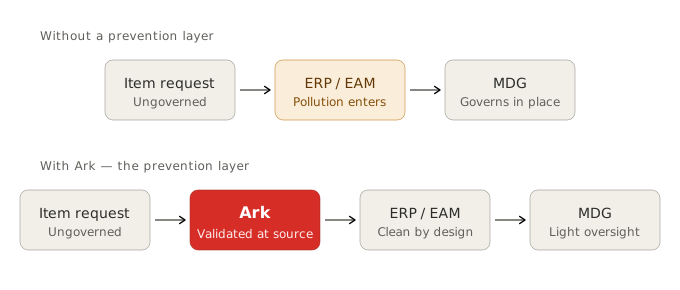
How We Deliver Results
Phase 1: Foundation Cleansing
Our data specialists conduct a comprehensive audit of your existing data ecosystem, eliminating years of accumulated inconsistencies, duplicates, and quality issues. You’ll emerge with a clean, reliable foundation ready for sustainable governance—setting the stage for long-term success. This applies across all three master data domains — items, vendors, and equipment assets.
Phase 2: Smart Governance Deployment
We implement intelligent data dictionaries and automated validation rules that work behind the scenes. New workflows ensure data quality at the point of creation while your teams continue their daily work without interruption. Quality becomes automatic, not an afterthought. Ark’s prevention-first validation and AI-powered classification govern Item, Vendor, and Asset records through domain-specific pipelines — each with its own data dictionaries, approval workflows, and quality rules.
Phase 3: Continuous Excellence
Your data stays clean with real-time monitoring and automated governance that prevents quality issues before they start. Watch procurement costs decrease and operational efficiency soar as your organization operates on trusted, consistent data that drives better decisions every day. Cross-master analytics surface vendor supply patterns, failure mode trends, procurement concentration risks, and maintenance planning insights — turning governed data into operational intelligence.
Zero disruption. Maximum impact. Permanent results.
Three Phases to Data Excellence
Now generally available: Identity Resolution & Duplicate Prevention.
Ark now manufactures part identity at the point of entry — and stops duplicates before the record exists.
The AI Intelligence Layer
MRO has no universal part identity. Manufacturer part numbers overlap and collide, the same part is described a dozen ways, and no shared key ties them together — which is why relational MDG can govern a product catalog but never an MRO one.
Ark closes that gap at the point of entry. The same intelligence proven in production on bulk engagements — over 60% full automation across hundreds of thousands of records — now runs on the single new part request: establishing a record’s identity, and checking it against everything already in your catalog, before the record exists. Not eventually. Now.
NEW
Identity Resolution
Give Ark a manufacturer part number and it returns a classified, attribute-complete record — specifications researched and filled, each with its source. The identity most MRO catalogs never had, built at the moment of entry.
NEW
Duplicate Prevention
Every new part is checked against your existing catalog the moment it’s created — compared on what it is, not how it’s spelled. Ark catches functional duplicates under different descriptions, different suppliers, even blank descriptions that keyword search can’t touch. Configurable by policy: warn, or hard-block the creation outright, with logged supervisor override. Prevention that actually prevents.
AI Classification
Every record semantically classified against Ark’s MRO taxonomy. The engine understands what the part actually is — not just which keywords appear.
Smart Attribute Extraction
Structured attributes pulled from unstructured, free-text descriptions — manufacturer names, part numbers, specifications, and material types mapped automatically.
Confidence-Based Routing
Every record scored and directed to the right path — in bulk processing, over 60% fully automated, the rest routed to experts with full AI-generated context.
Three Pipelines, One Governance Architecture
Most MDG products govern masters in isolation. Item Master here. Vendor Master there. Asset Master somewhere else. Connecting them requires ETL, a data warehouse, and a BI build — typically months of work, repeated every time the business asks a new question.
Ark governs three master data pipelines as a connected substrate. Each pipeline is purpose-built for its domain. All three share the same fabric, link through the same dictionaries, and answer cross-master questions natively — without ETL, without a separate analytics product, without a project.
Item Master Pipeline
Every MRO part request validated against enterprise data dictionaries, classified to industry-standard taxonomies, enriched with manufacturer and technical specifications — before it reaches your ERP. Duplicates caught at entry, not discovered months later during procurement. This is where Ark started 15 years ago, and it remains the most mature governance pipeline in the MRO market.
Vendor Master Pipeline
Supplier records governed with the same prevention-first discipline. Automated validation of vendor attributes, supply relationship mapping, and approval workflows that ensure every vendor record meets enterprise standards. Vendor-to-item linking creates the supply intelligence most organizations build manually in spreadsheets — if they build it at all.
Asset Master Pipeline
Equipment records linked to the items they consume and the vendors who supply them. Equipment type taxonomies, problem and failure mode dictionaries built in. The asset context that connects your parts catalog to your maintenance reality — turning “what do we stock” into “what does this equipment need, and who supplies it.”
Questions Your Current MDG Cannot Answer
- Vendor Supply Matrix — Which vendors supply parts for our most critical equipment? What’s our concentration risk if one fails?
- Failure Mode Analysis — Which parts have which failure modes on which equipment classes? Where is our reliability exposure?
- Procurement Risk — Single-source exposure, vendor concentration, lead time anomalies — weighted by equipment criticality and failure mode
- Maintenance Planning — Data-driven input for PM schedules, inventory positioning, and equipment lifecycle decisions
These aren’t reports your MDG product builds for you. They’re questions your operating leadership asks every month, and your MDG product cannot answer — because it governs each master in isolation. Ark answers them natively, because the masters were never separated to begin with.
Ark in Action — The Prevention Layer in Production
Both organizations evaluated SAP MDG and Oracle MDM before choosing Ark. Neither replaced their existing governance stack — they put Ark upstream of it.
The deployments below demonstrate Ark’s Item Master governance andAI classification capabilities in production — the prevention layer catching pollution at the source so the governance toolsdownstream have less to do. As customer deployments expand across Vendor and Asset Master pipelines, additional results will be published here.
Major Industrial Conglomerate
Multi-sector Manufacturing | 100K+ parts across business units
The Challenge
Years of decentralized procurement and inconsistent data practices created a fragmented MRO catalog across business units. With plans to consolidate onto a unified EAM platform, they needed clean, standardized data as the foundation—not just governance tools to control existing chaos.
The Ark Approach
We started where traditional MDG vendors don’t: comprehensive baseline cleansing to eliminate years of accumulated pollution. Only after establishing a clean foundation did we implement Ark’s prevention-first governance to maintain that quality permanently.
Results Delivered:
- ✓ 50,000+ duplicate parts identified and eliminated before EAM migration
- ✓ 1,200+ new categories defined with industry-standard classification framework
- ✓ 270,000+ master parts delivered with complete technical specifications
- ✓ Zero data quality degradation post-implementation through automated governance
- ✓ Millions in procurement savings through improved part findability and duplicate elimination
- ✓ 60-day implementation from start to full deployment
Critical Success Factor
Early stakeholder alignment on data governance policies and adequate resource allocation for baseline cleansing were essential. Organizations planning similar initiatives should secure executive commitment and dedicated funding upfront—attempting governance without first cleansing the foundation leads to governing pollution.
Major Manufacturing Brand
Consumer Goods Manufacturing | 50K+ parts across production facilities
The Challenge
Legacy systems contained inconsistent part descriptions, missing manufacturer part numbers, and poor classification—creating procurement inefficiencies and maintenance delays. Maintenance technicians spent more time searching for parts than performing actual maintenance work. Previous attempts at data cleansing provided temporary improvements that degraded within months.
The Ark Solution
We implemented Ark’s prevention-first governance platform to ensure every new MRO item meets enterprise standards before entering the system. Combined with targeted baseline data cleansing to address the most critical legacy issues, we established sustainable data quality.
Current Status - Platform in Production:
- ✓ Real-time data validation preventing new quality issues at the source
- ✓ Automated approval workflows streamlining part requests without manual bottlenecks
- ✓ Measurable improvement in technician productivity and part findability
- ✓ Sustained data quality that improves over time instead of degrading
- ✓ Active daily use across facilities with high user adoption
Critical Success Factor
The key to sustainable data quality was combining targeted baseline cleansing with prevention-first governance from day one. Organizations that skip the foundation cleansing step or try to implement governance on dirty data inevitably see quality degrade within months. User adoption proved critical—intuitive workflows and real-time validation meant technicians embraced the system rather than finding workarounds. For similar deployments, prioritize both cleaning legacy issues and preventing future pollution simultaneously.
Why These Organizations Chose Ark
Both organizations evaluated traditional MDG solutions (SAP MDG, Oracle MDM) and specialist vendors before selecting Ark. Here’s what differentiated us:
Prevention Over Remediation
Traditional governance tools put guardrails around messy data. Ark prevents pollution from entering your system in the first place—fundamentally different architecture.
Engineering Depth
We don’t just implement software—we engineer complete solutions including baseline cleansing, custom workflow development, system integration, and ongoing optimization.
MRO-Specific Expertise
Generic MDG tools require extensive customization for MRO complexity (technical specifications, manufacturer part numbers, multi-lingual catalogs). Ark is purpose-built, with 15 years of continuous platform engineering embedded.
Speed to Value
Our implementations deliver results in 45-60 days, not 6-12 months. Both organizations were operational faster than traditional MDG implementations—with better results.
Total Solution Approach
Product (Ark platform) + Services (data engineering) + Support (ongoing optimization) = complete solution, single vendor. No need to coordinate multiple consultants and tools.
AI Intelligence — From Bulk Processing to Governance
Our GenAI pipeline operates where the hardest MRO data problems live: large-scale classification, enrichment, and remediation of entire catalogs — hundreds of thousands of records processed with over 60% full automation. This is where AI delivers transformational value. No other MDG vendor has a production-grade AI pipeline for bulk MRO data processing. For individual individual record creation across Item, Vendor, and Asset pipelines, Ark’s data dictionaries and validation rules already enforce governance at the point of entry.
That evolution isn’t coming. It’s shipped. Ark now resolves a part’s identity the moment it’s entered — building it from a manufacturer part number, checking it against the entire catalog on what the part is rather than how it was typed, and stopping the duplicate at the door before the record exists. Not a similarity score to second-guess. A governed identity, matched fact by fact, every verdict auditable. Most vendors are still claiming this. We built it — and it works on your catalog out of the box.
The Sustainable Advantage
These deployments validated something critical: clean data doesn’t stay clean without the right governance architecture.
Both organizations had attempted data cleansing projects before. Within months, quality degraded back to previous levels because they lacked systems to prevent pollution at the source.
Ark’s prevention-first approach ensures data quality is permanent, not temporary:
✓ Real-time validation before data enters ERP/EAM—bad data never gets in
✓ Automated workflows that enforce standards without manual oversight
✓ AI-powered enrichment across Item, Vendor, and Asset records — researching missing information automatically with full source traceability
✓ Continuous monitoring that catches anomalies immediately
✓ Industry-standard taxonomies built in, not bolted on
✓ Cross-master relationships that connect items, vendors, and equipment — governance that spans your entire MRO data estate, not just one master at a time
The result: Data quality that improves over time instead of degrading—the opposite of traditional approaches.
From Request to ERP — Across Every Master
Ark creates a frictionless pipeline that takes item, vendor, and equipment records from initial request to ERP integration — automatically ensuring every piece of data meets enterprise standards.
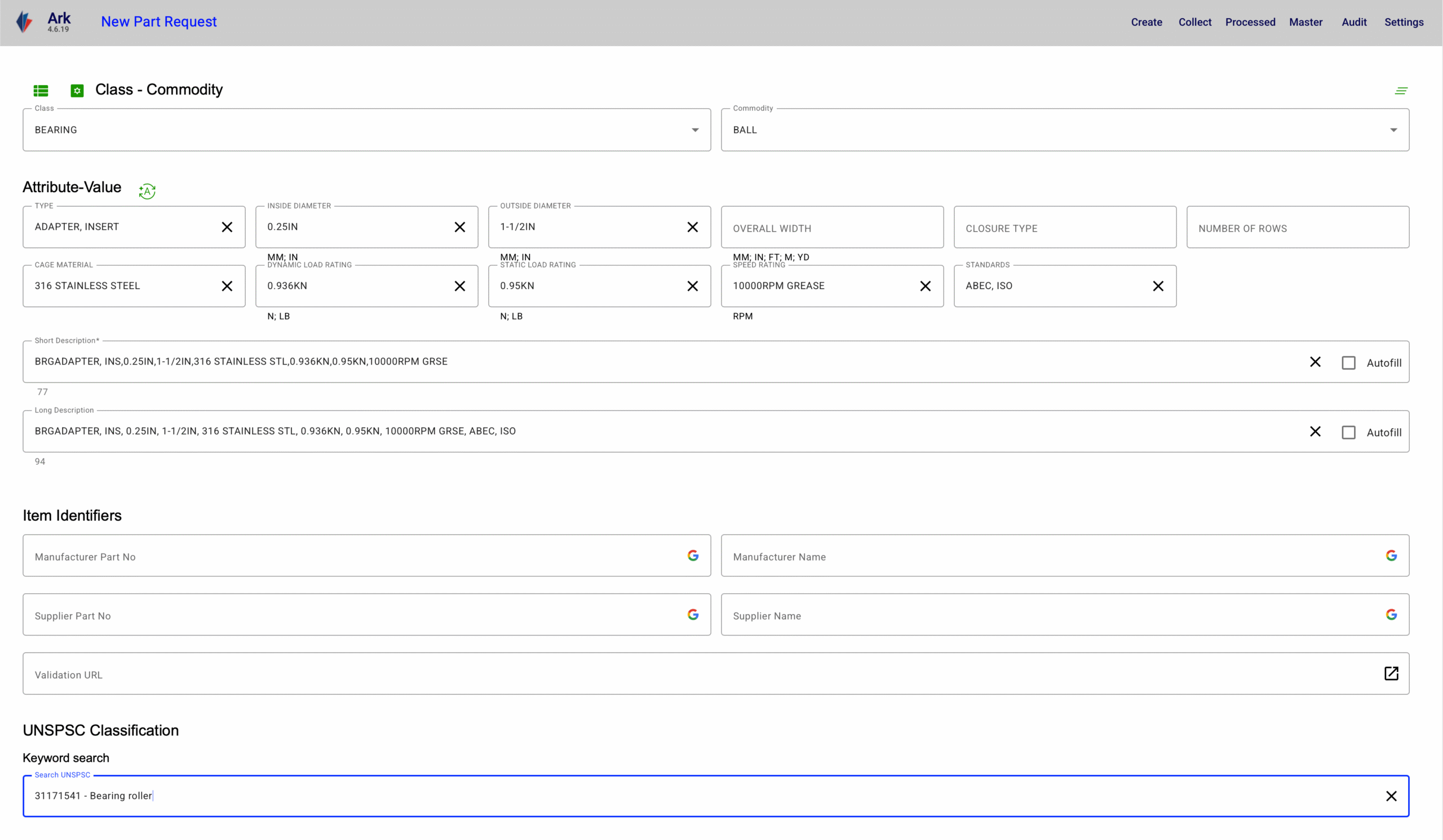
1: Effortless Capture
Teams submit item requests through intuitive interfaces designed for speed and accuracy, eliminating tedious manual processes.
Shown: Item Master workflow. Vendor and Asset Master pipelines follow the same prevention-first architecture with domain-specific validation.
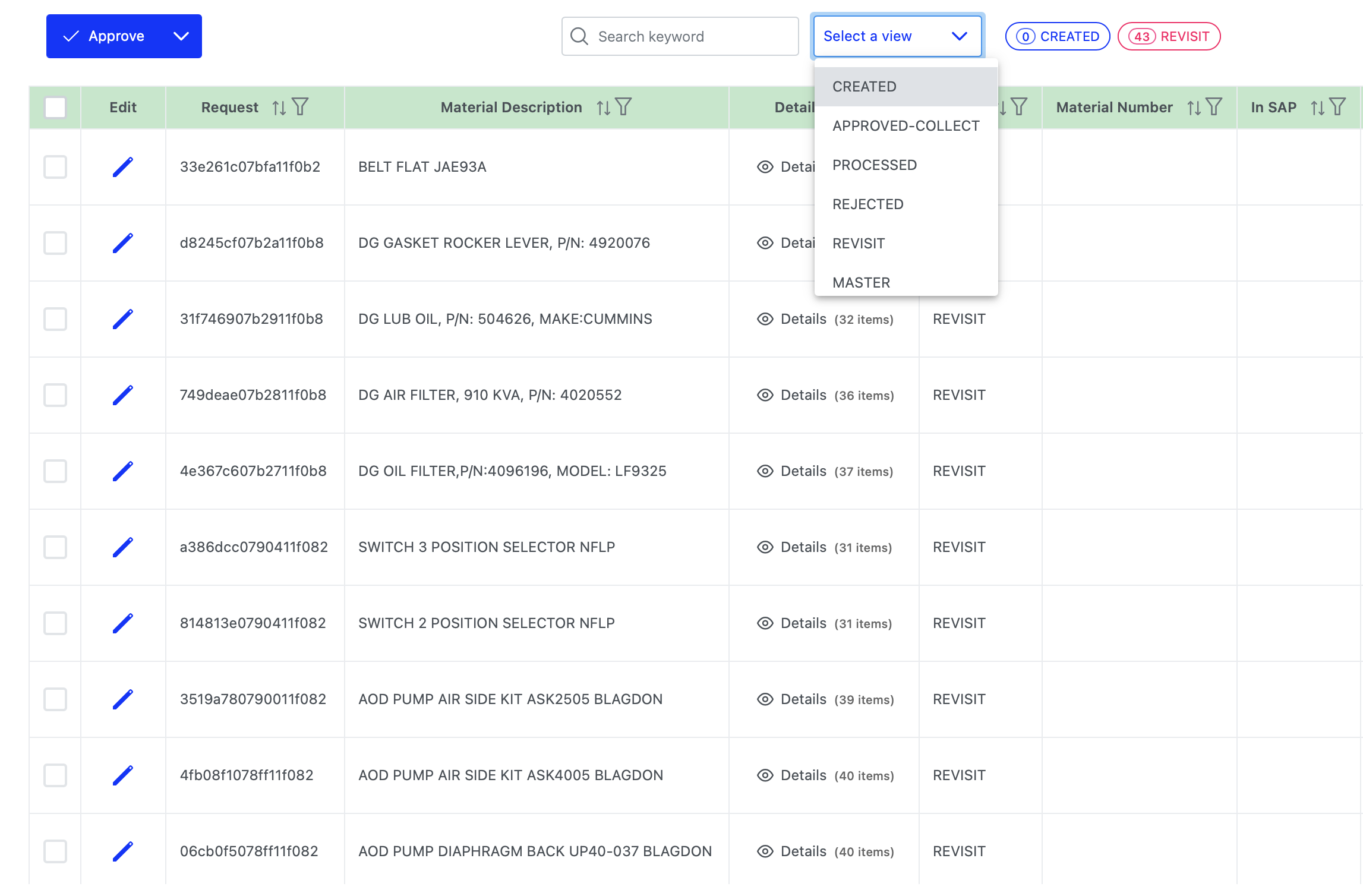
2: Smart Approval Workflows
Built-in review processes catch issues before they become problems, ensuring only validated data moves forward in your system.
Shown: Item Master workflow. Vendor and Asset Master pipelines follow the same prevention-first architecture with domain-specific validation.
3: Intelligent Standardization
Our Industry-standard data dictionaries automatically normalize and cleanse information, transforming inconsistent inputs into enterprise-ready data.
Shown: Item Master workflow. Vendor and Asset Master pipelines follow the same prevention-first architecture with domain-specific validation.
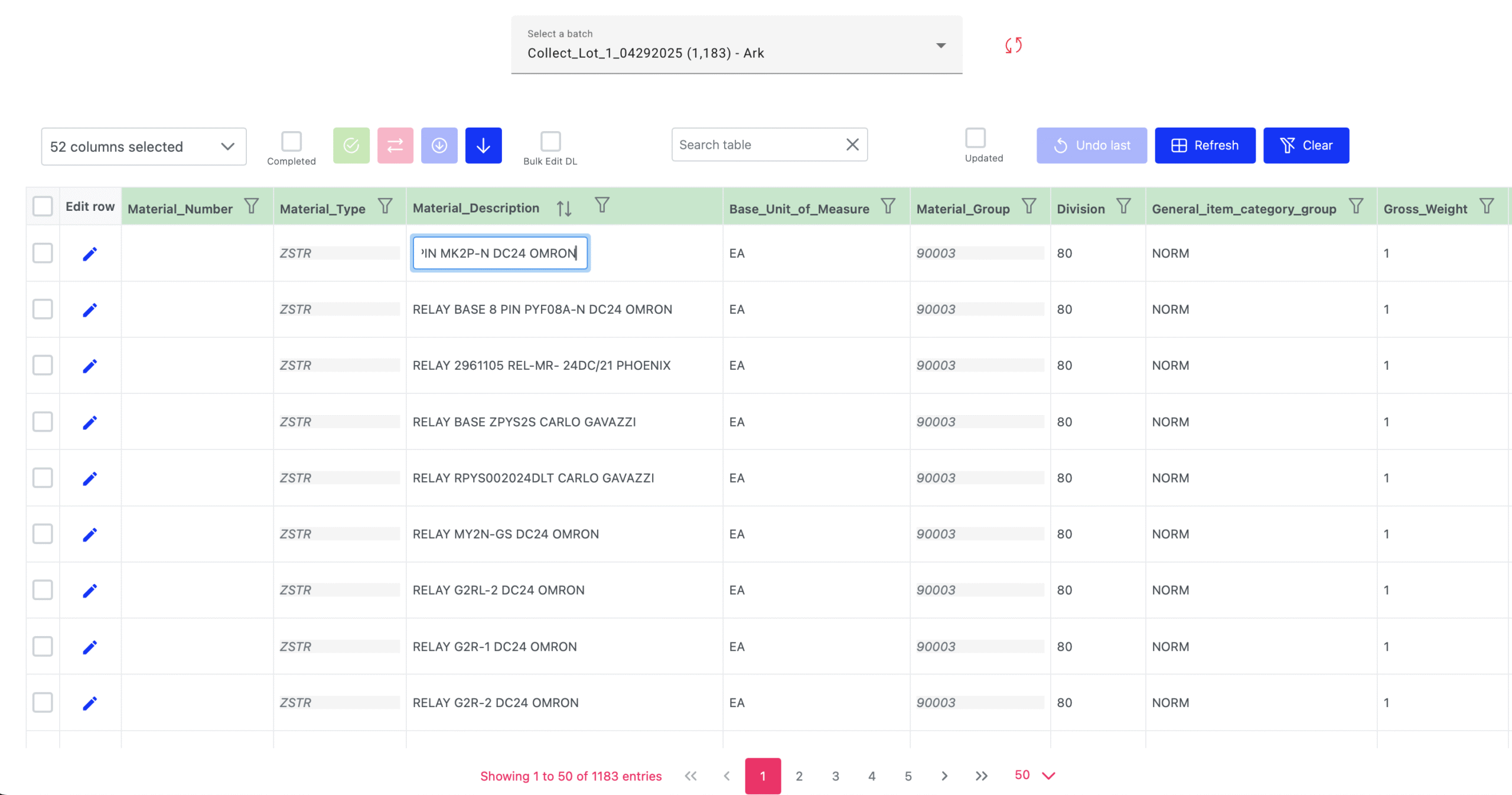
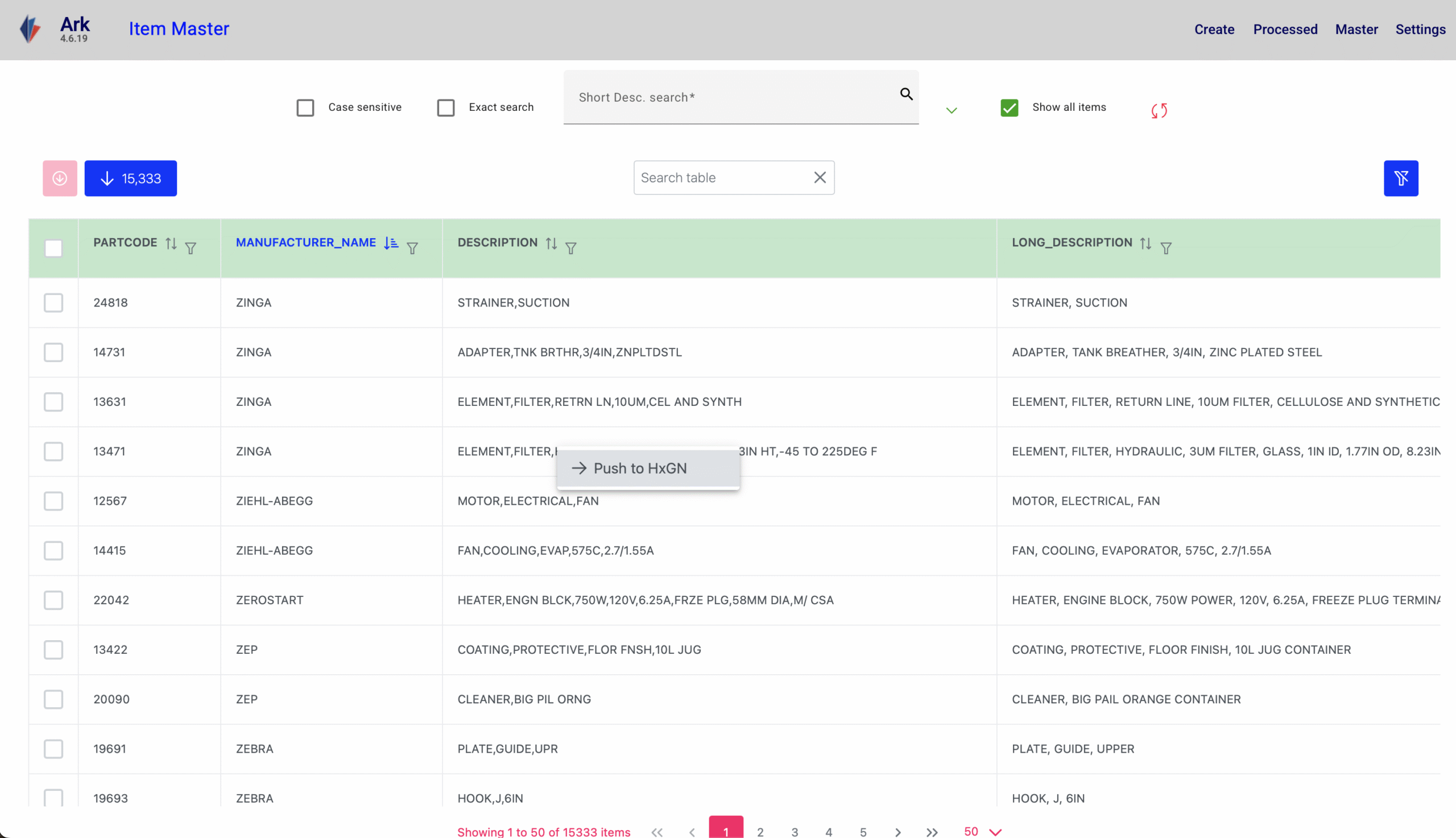
4: Seamless Integration
Ark integrates with your EAM/ERP through industry-standard protocols — OData, BAPI, REST API, and MIF — supporting SAP, Maximo, and other enterprise platforms. Clean, validated data pushed directly to your system of record. No manual re-entry. No format translation delays.
Shown: Item Master workflow. Vendor and Asset Master pipelines follow the same prevention-first architecture with domain-specific validation.
From request to system entry in minutes, not days. Every item standardized. Every entry accurate.
Deployment That Fits Your Reality
Ark deploys three ways, on the same codebase, with the same architecture:
SaaS — managed by Bluemind, fastest to operational, ideal for most organizations
Dedicated SaaS — your own Ark instance in our infrastructure, for organizations with data residency or isolation requirements
On-Premises — deployed in your environment, behind your firewall, for regulated industries that require it
No separate product line. No reduced feature set. The same Ark, in the deployment modality your business needs.
Ready to See Ark in Action?
Start With a Complimentary Data Quality Assessment
Whether you’re planning an EAM migration, struggling with procurement inefficiencies, or simply tired of fighting the same data quality battles—we can help.
Let’s start with a complimentary assessment of your MRO data:
What You'll Get:
- Analysis of a sample of your MRO data (10K-25K parts)
- Quantified assessment of duplicates, missing fields, and classification gaps
- Estimated annual cost impact of current data quality issues
- Tailored recommendations for improvement
- No obligation—just clear insights
What Happens Next:
- Share a data sample (we sign NDA first)
- We analyze and prepare detailed findings
- 60-minute review session to discuss results
- If interested, we propose an Ark implementation plan
Frequently Asked Questions
Can you share the names of these customers?
Both organizations prefer to keep their Ark deployments confidential at this time for competitive and strategic reasons. We respect their privacy while sharing the measurable results they’ve achieved. As more customers go public with their success stories, we’ll feature them prominently.
What is the "Prevention Layer"?
The Prevention Layer is the architectural position Ark occupies in your enterprise data stack. Unlike traditional MDG tools that sit inside your ERP and govern data already in the system, the Prevention Layer sits upstream — validating, classifying, and enriching every MRO record before it enters your ERP/EAM.
The distinction is structural, not cosmetic. Once data is in your system, governing it in place can only catch some issues; it cannot prevent them. The Prevention Layer prevents.
How long does Ark implementation typically take?
Implementation timelines depend on catalog size and complexity. Most deployments are fully operational within 45-60 days, including baseline data cleansing. This is significantly faster than traditional MDG implementations which typically require 6-12 months. Our engineering approach and MRO-specific platform eliminate lengthy customization cycles.
What happens to our existing data?
We conduct comprehensive baseline cleansing as Phase 1, eliminating duplicates and fixing quality issues in your existing catalog. This creates the clean foundation necessary for effective governance. Then Ark maintains that quality going forward by preventing new issues from entering the system. You get both immediate improvement and long-term sustainability.
Do we need to hire a separate consulting firm for implementation?
No. Bluemind provides complete end-to-end implementation including data engineering, platform deployment, workflow configuration, system integration, and user training. Our engineering depth means you work with one team that handles everything from baseline cleansing through ongoing optimization. Single vendor, single point of accountability.
What if we're not ready for full implementation?
We offer structured pilots that let you see results before committing to full deployment. A typical pilot processes a subset of your data (25K-50K parts) over 30 days and demonstrates measurable improvements in quality, efficiency, and cost impact. Many organizations start with pilots to build internal buy-in before scaling across the enterprise
How is Ark different from SAP MDG or Oracle MDM?
Three differences, each structural rather than cosmetic.
Architecture. SAP MDG and Oracle MDM are built on relational databases designed for stable, structured product and customer records. Ark is built on a schemaless document substrate with native search, designed for MRO’s text-heavy, attribute-rich, dictionary-driven data. The architecture matches the domain. Theirs doesn’t.
Position in the stack. SAP MDG and Oracle MDM govern data that’s already in your ERP. Ark sits upstream, preventing pollution before it enters. Once data is in your system, governing it in place can only catch some issues; it cannot prevent them.
Cross-master capability. Their products govern masters in isolation, with cross-domain analytics requiring ETL, a warehouse, and a BI build. Ark’s masters share a substrate and link through dictionaries — so cross-master questions answer themselves without a separate analytics product.
All three differences compound. Implementations that take 6-12 months on SAP MDG run 45-60 days on Ark. Cross-master analytics that require a quarter of BI work happen at query time. New masters onboard as tier subscriptions, not projects.
What about ongoing costs and support?
Ark licensing includes platform access, system maintenance, regular updates, and standard support. Implementation services (baseline cleansing, configuration, integration, training) are separate one-time costs. We also offer managed services for organizations that prefer ongoing data stewardship support. We’ll provide transparent cost estimates during the assessment phase based on your specific requirements.
How does Ark use AI?
Ark runs a GenAI intelligence layer — a pipeline proven in production on bulk MRO data processing engagements.
Today, the AI pipeline operates at scale in our data engineering services: semantically classifying MRO records against industry-standard taxonomies, extracting structured attributes from unstructured descriptions, enriching incomplete records with researched specifications and source provenance, and scoring each record by confidence to route it to the appropriate processing path. Over 60% of records are processed with zero human intervention.
These same capabilities now operate at the point of data entry, not just in bulk remediation. When a new part is created, Ark establishes its identity — classifying it, enriching it from its manufacturer part number, and checking it against your existing catalog for duplicates — before the record is admitted. On an exact match, Ark can block the creation outright, overridable only by a supervisor and always logged. Ark’s rules-based engine provides the foundation; the AI engine adds the speed, accuracy, and identity resolution that rules alone cannot deliver.
How does Ark handle manufacturer part numbers and duplicates at entry?
Two ways, both at the point of creation. First, identity resolution: give Ark a manufacturer part number and it builds a classified, attribute-complete record, specifications researched, each with its source. Second, duplicate prevention: every new part is compared against your existing catalog on what it is, not how it’s spelled — so functional duplicates (same part, different description, different supplier, even blank descriptions) are caught before they’re created, not discovered months later in procurement. On an exact match, Ark can block creation outright, with logged supervisor override. MRO has never had a universal identity key. Ark supplies one at entry.
Is the AI accurate enough for MRO data?
This is the right question — and it’s where most AI implementations fail. Generic AI models don’t understand MRO data complexity: the difference between a pump seal and a seal kit, the relationship between OEM and aftermarket part numbers, the nuances of industry-specific classification taxonomies.
Our AI is grounded in 15 years of continuous Ark platform engineering on real MRO data. The taxonomy, validation rules, and enrichment logic reflect real-world industrial knowledge — not generic training data.
And critically, AI never writes directly to production. Every AI-generated classification and enrichment passes through a deterministic validation layer. Errors are caught before they enter your system — not after they’ve contaminated your master data. The result is AI speed with engineering-grade accuracy.
In bulk processing engagements, this approach consistently delivers over 60% full automation with production-grade accuracy. As these capabilities integrate into Ark’s real-time workflows, the same validation principles apply.
Does Ark handle Vendor and Asset data, or just Item/Parts data?
Ark governs three master data domains: Item Master, Vendor Master, and Asset Master. Each has its own pipeline with domain-specific validation, classification, and approval workflows. Cross-master linking connects them — so you can see which vendors supply which parts for which equipment types, and surface analytics across the full relationship.
Which industries does Ark serve?
Ark is deployed across asset-intensive industries including manufacturing, aerospace MRO, energy and utilities, and industrial operations. Our data dictionaries and classification taxonomies are built for MRO complexity across these verticals. → See our industry focus page for details